
How Do You Choose the Right Odoo Implementation Partner?
Choosing the right Odoo implementation partner is an important decision for any business planning to improve its operations with ERP software. The right partner can help you select suitable Odoo applications, streamline business processes, migrate existing data, and configure a system that supports your business goals.
However, choosing an unsuitable implementation partner can lead to unexpected costs, project delays, unnecessary customization, and difficulties after deployment.
So, how do you choose the right Odoo implementation partner for your business? In this guide, we explain the key factors to consider, the questions to ask before hiring a provider, and how to find a partner that aligns with your business requirements.
What Is an Odoo Implementation Partner?
An Odoo implementation partner helps businesses plan, configure, customize, and deploy Odoo ERP according to their operational requirements.
Depending on the project scope, services may include:
-
Business requirement analysis
-
Odoo module selection and configuration
-
ERP implementation and customization
-
Data migration from existing software
-
Third-party application integration
-
Testing and quality assurance
-
Employee training
-
Technical support and maintenance
A good implementation partner focuses on understanding your business processes before recommending a technical solution.
Why Is Choosing the Right Odoo Implementation Partner Important?
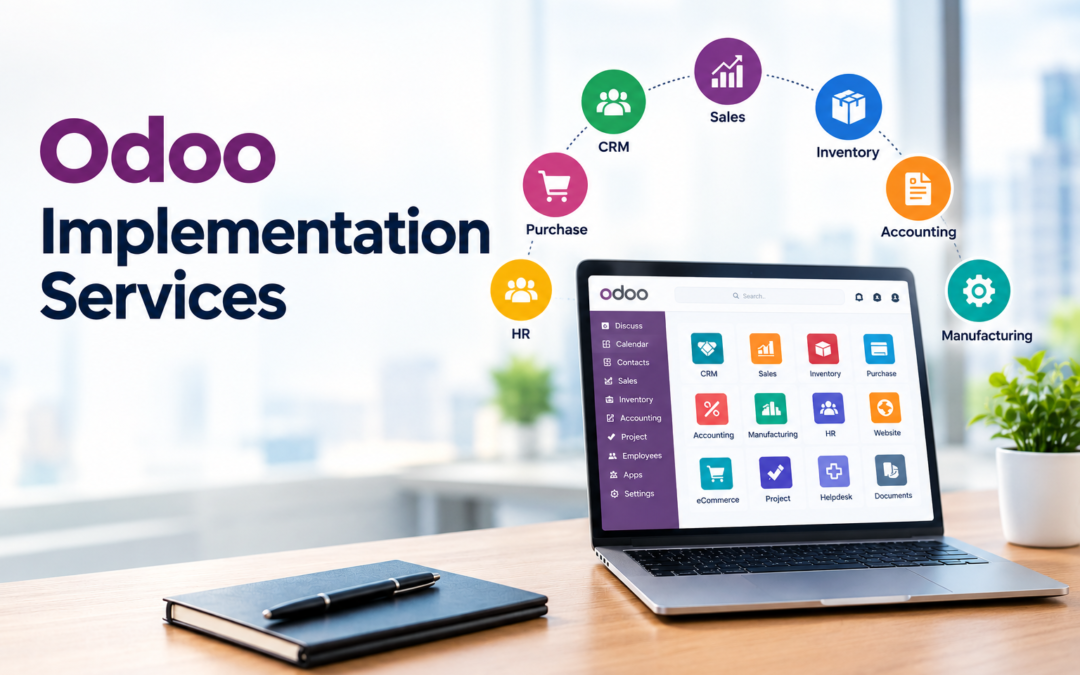
Odoo ERP can connect different business functions, including sales, CRM, accounting, inventory, purchasing, manufacturing, and project management.
However, the results depend on how effectively the system is planned and configured.
The right Odoo implementation partner can help your business:
-
Improve operational efficiency by streamlining workflows.
-
Reduce repetitive manual tasks through suitable automation.
-
Connect business departments using integrated applications.
-
Improve data accuracy through structured processes.
-
Generate useful reports for business decision-making.
-
Prepare the ERP system for future business growth.
-
Receive technical assistance when issues arise.
Selecting a suitable partner helps establish a strong foundation for your ERP project.
7 Factors to Consider When Choosing an Odoo Implementation Partner
1. Check Odoo Experience and Technical Expertise
Start by evaluating the provider’s experience with Odoo ERP implementation projects.
An experienced team should understand Odoo configuration, module selection, customization, data migration, integrations, testing, and deployment.
Ask potential partners about projects they have completed and whether they have worked with businesses that have requirements similar to yours.
You can also ask whether they have relevant Odoo certifications or official partner status. Verify any claimed credentials independently.
What to ask: Have you implemented Odoo for businesses with similar operational requirements?
2. Understand Your Business Requirements
Every business has different processes, challenges, and priorities. A suitable Odoo implementation partner should understand these differences before recommending a solution.
For example, a trading business may require Sales, Purchase, Inventory, and Accounting applications, while a service company may need CRM, Project, Sales, and timesheet-related workflows.
Your implementation partner should review your current processes, identify operational gaps, and recommend suitable Odoo applications.
What to ask: How will you analyze our business requirements before selecting the Odoo modules?
3. Evaluate Customization and Integration Capabilities
Standard Odoo features may meet many business requirements, but some organizations need additional functionality.
Your implementation partner should be able to assess whether a requirement can be handled through standard configuration, an existing supported integration, or custom development.
Possible requirements include:
-
Custom business reports and dashboards
-
Industry-specific workflows
-
Third-party software integrations
-
Automated approval processes
-
Custom modules and additional functionality
Avoid unnecessary customization because it can increase project costs and future maintenance requirements.
What to ask: Can you explain which requirements need customization and which can be handled using standard Odoo features?
4. Review the Implementation Process and Timeline
A reliable implementation partner should provide a clear project plan rather than promising results without understanding the scope.
The plan should identify important stages, including requirement analysis, configuration, migration, customization, testing, training, and deployment.
Ask the provider to explain project milestones, responsibilities, expected deliverables, dependencies, and how changes to the original scope will be managed.
The actual timeline will depend on the complexity of the project, number of modules, data quality, and integration requirements.
What to ask: What are the project milestones, expected timeline, and responsibilities for our team?
5. Compare Pricing and Project Transparency
Odoo implementation costs vary according to business requirements and project complexity. Comparing proposals based only on the total price may not provide a complete picture.
Request a detailed quotation that explains the included services and any additional charges.
Review costs associated with:
-
Implementation and configuration
-
Custom development
-
Third-party integrations
-
Licensing and hosting, where applicable
-
Employee training
-
Post-implementation support
A transparent proposal should also explain assumptions, exclusions, payment milestones, and how additional work will be charged.
What to ask: What is included in your quotation, and what could result in additional costs?
6. Check Training and Post-Implementation Support
Odoo implementation does not end when the software goes live. Employees need training, and businesses may require technical assistance as they begin using the system.
Before selecting a partner, understand what happens after deployment.
Check whether the provider offers:
-
Role-based employee training
-
User documentation
-
Technical troubleshooting
-
Bug fixing and maintenance
-
Assistance with configuration changes
-
Upgrade planning and ongoing support
Clarify support hours, response expectations, service terms, and whether support is included in the project price or charged separately.
What to ask: What support will be available after the system goes live?
7. Review Client References and Communication
A successful ERP project requires regular communication between the implementation team and your employees.
Ask for relevant case studies, client references, or project examples where available. Look for evidence that the provider understands business needs, communicates clearly, and manages implementation challenges effectively.
During initial discussions, evaluate how well the team answers your questions and explains technical decisions in understandable language.
A partner that communicates clearly can help your team make informed decisions throughout the project.
What to ask: Can you share relevant project examples or references, and how will we communicate during implementation?
What Questions Should You Ask Before Hiring an Odoo Partner?
Before making a final decision, prepare a list of questions to compare potential implementation providers.
Here are some useful questions:
-
What experience do you have with Odoo ERP implementation?
-
Have you worked with businesses in our industry?
-
Which Odoo applications do you recommend for our requirements?
-
What is your approach to data migration and validation?
-
Which requirements need customization or third-party integration?
-
What is the estimated project timeline and cost?
-
How will you test the system before deployment?
-
What training will you provide to employees?
-
What technical support is available after implementation?
-
How will you handle future changes and business growth?
Compare the answers alongside each provider’s experience, proposal, project methodology, and support arrangements.
What Are the Common Mistakes to Avoid When Choosing an Odoo Partner?
Businesses can reduce implementation risks by avoiding several common mistakes.
Choosing based only on price: A low initial quotation may exclude important services, such as data migration, training, or support.
Ignoring business requirements: Selecting software modules before understanding business processes can result in an unsuitable implementation.
Over-customizing Odoo: Excessive customization can increase costs and make future upgrades more complicated.
Overlooking employee training: Employees may struggle to adopt new workflows without appropriate guidance.
Not defining project scope: Unclear deliverables and responsibilities can lead to delays and disagreements.
Ignoring post-launch support: A lack of support planning can make it difficult to resolve issues after deployment.
A structured evaluation process helps businesses make a more informed decision.
Why Consider FadelSoft for Odoo Services?
FadelSoft provides technology solutions designed to help businesses improve operations and adopt digital tools aligned with their goals.
If your organization is evaluating Odoo ERP, you can discuss your requirements with the FadelSoft team to explore suitable applications, configuration options, customization needs, and implementation priorities.
Before beginning an ERP project, it is useful to identify your current operational challenges, document your goals, and understand which processes need improvement. This creates a stronger foundation for selecting an appropriate solution.
To learn more about FadelSoft, visit our website:
Website: https://fadelsoft.com/
Frequently Asked Questions
1. How do I choose the right Odoo implementation partner?
Evaluate the provider’s Odoo experience, understanding of your business, technical capabilities, project methodology, pricing transparency, training services, and post-implementation support.
2. Why should I hire an Odoo implementation partner?
An implementation partner can help analyze requirements, configure Odoo, migrate data, manage integrations, test workflows, and train employees. This can reduce implementation risks when the project is properly planned.
3. How much does an Odoo implementation partner cost in India?
The cost depends on project scope, required applications, customization, integrations, data migration, training, and support. Request a detailed quotation based on your specific requirements.
4. How long does Odoo ERP implementation take?
The timeline varies according to business complexity. A relatively straightforward project may take weeks, while a larger implementation involving multiple departments and extensive customization may take several months or longer.
5. Can an Odoo implementation partner customize Odoo?
Yes. Depending on technical feasibility and project requirements, a provider can configure standard features, develop custom modules, create reports, and integrate external systems.
6. What support should an Odoo implementation partner provide?
Support may include troubleshooting, bug fixes, user assistance, maintenance, configuration changes, and upgrade planning. Confirm the exact services and response expectations before signing an agreement.
Conclusion
Choosing the right Odoo implementation partner is essential for building an ERP system that supports your business requirements and long-term goals.
By evaluating Odoo experience, business understanding, customization capabilities, implementation planning, pricing transparency, and post-launch support, you can make a more informed decision.
Take time to compare providers, ask the right questions, and define your project requirements before committing to an implementation.
Looking for technology solutions for your business? Connect with FadelSoft to discuss your requirements and explore the next steps toward digital transformation.
FadelSoft — Technology That Helps Your Business Grow.