
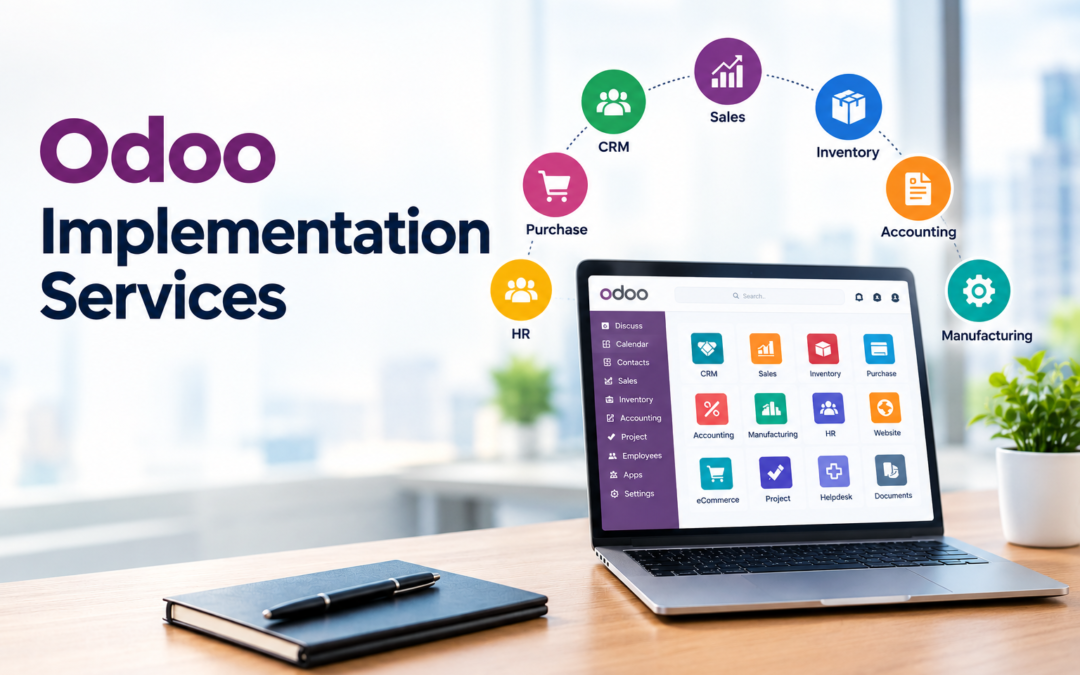
Odoo Implementation Services in India: How Odoo Works, Implementation Process and Cost
Are you looking for a better way to manage your business operations, sales, inventory, accounting, and customer relationships? Managing these activities through separate software, spreadsheets, and manual processes can make business operations complicated.
Odoo ERP offers an integrated business management solution that helps companies organize their operations through connected applications. With the right Odoo implementation services in india, businesses can configure the software according to their requirements, automate suitable workflows, and improve operational visibility.
In this guide, we explain how Odoo works, how to implement Odoo ERP, what affects Odoo implementation costs in India, and how to choose the right Odoo implementation company.
What Is Odoo ERP?
Odoo is an enterprise resource planning (ERP) platform that provides applications for managing different business functions in one integrated system.
Businesses can select the applications they need based on their industry, size, and operational requirements.
Some popular Odoo applications include:
-
Odoo CRM: Manage leads, sales opportunities, and customer relationships.
-
Odoo Sales: Create quotations, process sales orders, and manage sales activities.
-
Odoo Accounting: Organize invoices, payments, and financial records, subject to the selected localization and configuration.
-
Odoo Inventory: Track products, stock movements, and warehouse operations.
-
Odoo Purchase: Manage suppliers, purchasing, and procurement workflows.
-
Odoo Manufacturing: Coordinate production activities and manufacturing operations.
-
Odoo HR: Manage employee-related information and supported HR processes.
-
Odoo Website and eCommerce: Create websites and manage online business activities.
By connecting the appropriate applications, companies can reduce information gaps between departments and manage business processes more efficiently.
How Does Odoo Work?
Odoo works through a collection of integrated business applications. Each application supports a specific business function, while connected applications can share relevant records and information.
For example, consider a business that sells products to customers.
-
A potential customer is recorded in Odoo CRM.
-
The sales team manages the opportunity and prepares a quotation.
-
Once the order is confirmed, the relevant sales and inventory workflows can be initiated.
-
Inventory operations help manage product availability and delivery.
-
Invoicing and accounting workflows support the financial side of the transaction.
-
Managers can review available reports to understand sales and operational performance.
The exact workflow depends on the applications installed, system configuration, and business requirements.
Key Benefits of Odoo ERP
Centralized business information: Connect relevant business records across departments.
Reduced manual work: Automate supported repetitive activities and reduce duplicate data entry.
Improved customer management: Organize customer enquiries, sales opportunities, and follow-ups.
Better inventory visibility: Track stock levels and product movements through configured inventory workflows.
More accessible reporting: Use available reports and dashboards to monitor business performance.
Flexible business management: Start with the applications you need and expand the system as requirements change.
What Are Odoo Implementation Services in india?
Odoo implementation services in india involve planning, configuring, testing, and deploying Odoo ERP to support a company’s business operations.
An implementation provider works with your team to understand existing processes, select suitable applications, prepare business data, and configure the system.
Depending on the project scope, Odoo implementation services in india may include:
-
Business requirement analysis
-
ERP implementation planning
-
Odoo module selection and configuration
-
Business process customization
-
Custom module development
-
Data migration from existing software
-
Third-party software integration
-
System testing and employee training
-
Go-live support and maintenance
The objective is to implement a system that supports actual business requirements rather than adding unnecessary complexity.
How to Implement Odoo ERP: Step-by-Step Process
A successful Odoo implementation requires proper planning, technical preparation, and employee involvement. The following steps provide a practical overview.
Step 1: Analyze Your Business Requirements
Start by identifying the problems you want to solve.
For example, your business may need better inventory control, improved sales tracking, connected accounting workflows, or fewer manual tasks.
Document your existing processes, required features, user roles, reporting needs, and project priorities.
Step 2: Choose the Right Odoo Applications
Select applications based on your requirements.
A trading company may need CRM, Sales, Purchase, Inventory, and Accounting. A manufacturing business may also require Manufacturing and additional operational applications.
Starting with the essential applications can help keep the implementation scope manageable.
Step 3: Configure Odoo for Your Business
The system is configured to support your business rules, user permissions, approval processes, and workflows.
Whenever possible, standard Odoo functionality should be evaluated before introducing custom development. This can help reduce unnecessary complexity and simplify maintenance.
Step 4: Customize and Integrate the System
Some businesses need features that are not fully covered by standard functionality.
Depending on the requirements, an implementation team may develop custom modules or integrate Odoo with existing applications, payment services, eCommerce platforms, or other systems.
Each customization should have a clear business purpose.
Step 5: Migrate Existing Business Data
Companies may need to transfer information from spreadsheets, legacy software, or another ERP system.
Data migration typically involves reviewing, cleaning, mapping, and importing the required information. This may include customer records, supplier details, product information, inventory data, and relevant opening balances.
The migrated data should be validated before the system goes live.
Step 6: Test the System and Train Employees
Before deployment, test important workflows such as sales orders, purchasing, inventory movements, invoicing, reporting, and integrations.
Employees should receive training based on their responsibilities so they can use the system confidently.
Step 7: Deploy Odoo ERP
After testing and approval, the business begins using Odoo for the agreed project scope.
A go-live plan should cover final data checks, access permissions, operational readiness, and a process for resolving issues.
Step 8: Provide Ongoing Support
After implementation, businesses may need technical assistance, additional configurations, performance improvements, or future upgrades.
Ongoing support helps the system continue to meet changing business requirements.
How Much Does Odoo Implementation Cost in India?
Odoo implementation cost in India depends on the complexity of the project, the number of users, the required applications, customization, data migration, and integration requirements.
There is no single implementation price suitable for every business.
The main factors affecting Odoo implementation costs include:
1. Number of Odoo Applications
A project involving a few applications may require less configuration and testing than one connecting multiple departments.
2. Business Process Complexity
Companies with straightforward workflows may need less implementation effort than businesses with complex approval processes, multiple warehouses, or specialized manufacturing requirements.
3. Customization and Development
Custom modules, advanced workflows, and specialized reports can increase development and testing requirements.
4. Data Migration
The amount, quality, and format of existing business data affect the time required to prepare and migrate information.
5. Third-Party Integrations
Connecting Odoo with other business systems can add integration, testing, and maintenance requirements.
6. Licensing, Hosting, Training, and Support
The total cost of ownership may also include Odoo licensing where applicable, hosting, employee training, ongoing support, and future maintenance. These costs depend on the selected edition, deployment approach, and service agreement.
How Can You Get an Accurate Odoo Implementation Quote?
Before requesting a quotation, prepare the following information:
-
Your industry and business requirements
-
The number of employees or system users
-
The applications you want to implement
-
Existing software and data sources
-
Required customizations and integrations
-
Your preferred implementation timeline
Ask the implementation company to provide a clear breakdown of project scope, deliverables, implementation charges, recurring expenses, and post-launch support.
This makes it easier to compare proposals and understand the total investment.
How to Choose the Right Odoo Implementation Company in India
Selecting an Odoo implementation company is an important decision because implementation quality can affect how effectively the system supports your business.
Before choosing a provider, consider the following factors.
Business Understanding
The provider should understand your existing operations and recommend applications that address your actual requirements.
Technical Expertise
Look for the capabilities required for configuration, customization, integrations, and data migration.
Transparent Pricing
A detailed quotation should explain the project scope, expected deliverables, additional costs, and support arrangements.
Project Planning
The company should provide a practical implementation roadmap with milestones for configuration, testing, training, and deployment.
Training and Support
Employee training and post-implementation support are important for long-term adoption and system reliability.
Scalability
Choose a solution that can accommodate your future requirements without unnecessary complexity today.
Ask potential providers to explain their proposed approach and demonstrate how it addresses your business challenges before making a decision.
Why Consider Fadel Software Solutions for Odoo Implementation?
Fadel Software Solutions helps businesses explore technology solutions that support operational efficiency and digital transformation.
If your business is planning to adopt Odoo ERP, FadelSoft can discuss your requirements for implementation planning, application configuration, customization, data migration, system integration, deployment, and ongoing support.
The appropriate scope, timeline, and services should be established after understanding your business needs.
Whether you are evaluating ERP software for the first time or considering a move from disconnected business applications, a requirement assessment can help identify the most suitable implementation approach.
Website: https://fadelsoft.com
Email: info@fadelsoft.com
Frequently Asked Questions About Odoo Implementation
What is Odoo implementation?
Odoo implementation is the process of configuring, preparing, testing, and deploying Odoo ERP to support a company’s business operations. It may include application selection, customization, data migration, integration, and training.
How does Odoo work for small businesses?
Odoo allows small businesses to use applications for activities such as sales, CRM, inventory, invoicing, and purchasing. Businesses can select applications based on their needs and connect relevant workflows.
How do I implement Odoo ERP in my company?
Start by documenting your business requirements, selecting the appropriate applications, planning the configuration, preparing existing data, testing workflows, and training employees. You can work with an implementation provider if you need technical expertise or project support.
How much does Odoo implementation cost in India?
The cost depends on the required applications, number of users, business complexity, customization, integrations, migration requirements, and ongoing services. Request a project-specific quotation based on your requirements.
How do I find an Odoo implementation company in India?
Evaluate providers based on their understanding of your business, technical capabilities, implementation approach, pricing transparency, training, and ongoing support. Request a detailed proposal before choosing a provider.
Is Odoo suitable for manufacturing and trading businesses?
Odoo offers applications for manufacturing, inventory, sales, and purchasing. Suitability depends on your business processes, operational requirements, and the configuration of the selected applications.
Conclusion
Odoo ERP can help businesses connect operations, organize information, automate supported workflows, and improve visibility across departments. However, successful implementation requires careful planning, appropriate application selection, reliable data, employee training, and ongoing support.
Understanding how Odoo works, what affects implementation costs, and how to select a suitable provider can help you make a more informed decision.
If you are looking for Odoo implementation services in India, contact Fadel Software Solutions to discuss your business requirements and explore a suitable implementation approach.
Ready to modernize your business operations? Start by evaluating how Odoo ERP can support your goals.