
Introduction
Managing a distribution or logistics business involves several activities, including inventory management, purchasing, sales, warehouse operations, order processing and accounting. When these activities are handled using separate software, spreadsheets and manual processes, businesses often experience delays, stock discrepancies and difficulties tracking daily operations.
This is where Odoo ERP for distribution and logistics in India can make a difference.
Odoo ERP provides an integrated business management platform that connects different departments through a centralized system. It helps distributors, wholesalers, traders and logistics companies manage inventory, automate workflows, monitor deliveries and improve operational efficiency.
In this guide, we will explore how Odoo ERP works for distribution and logistics businesses, its important modules, GST features, implementation costs, timelines and the benefits of choosing the right implementation partner.
What Is Odoo ERP for Distribution and Logistics?
Odoo is an integrated Enterprise Resource Planning (ERP) platform designed to manage different business operations within one system.
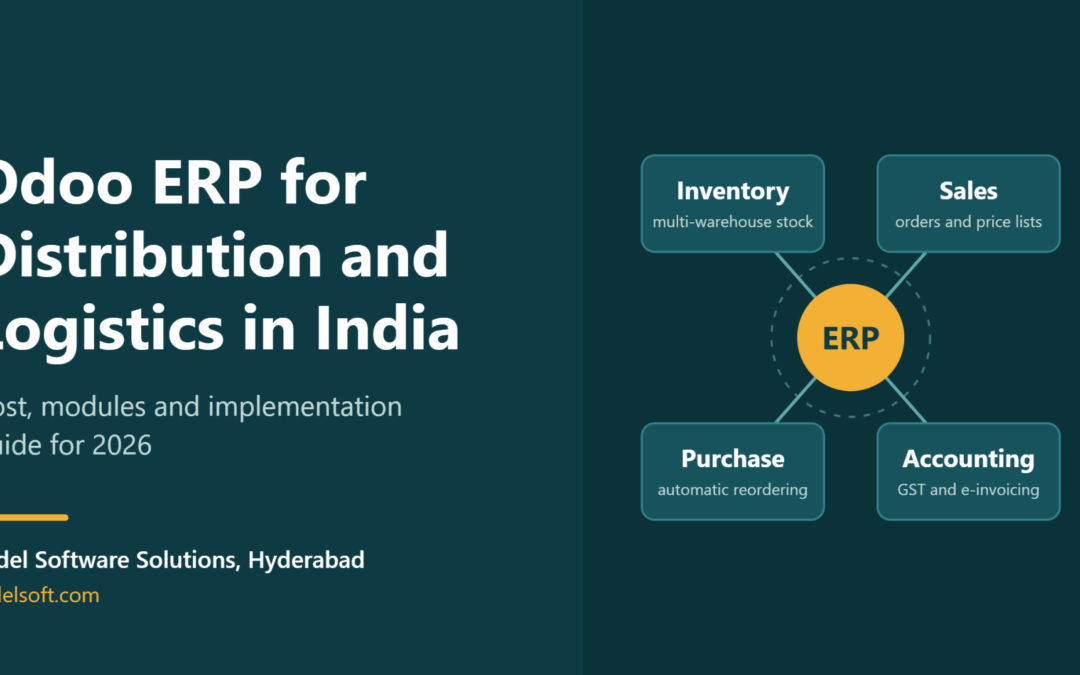
For distribution and logistics companies, Odoo connects sales, inventory, purchasing, accounting, customer management and warehouse operations. Odoo ERP for distribution and logistics in India
For example, when a customer places an order, the sales team can create a sales order in Odoo. The inventory team can check product availability, process delivery and update stock quantities. The accounting department can generate invoices and record payments using the same system.
This connected workflow reduces repetitive data entry and improves coordination between departments. Odoo ERP for distribution and logistics in India
Odoo is particularly useful for:
-
Wholesale and distribution companies
-
Retail distributors
-
Manufacturing and supply chain businesses
-
Logistics and transportation companies
-
Import and export businesses
-
Multi-warehouse operations Odoo ERP for distribution and logistics in India
Why Do Distribution Businesses in India Need Odoo ERP?
As distribution businesses expand, managing daily operations becomes more complicated. Traditional billing software and spreadsheets may not provide the visibility required to manage multiple warehouses, suppliers and customers. Odoo ERP for distribution and logistics in India
Some common challenges include:
1. Inventory Management Problems
Businesses may struggle to track stock across multiple warehouses. Incorrect inventory information can result in overstocking, stock shortages and delayed deliveries.
2. Manual Order Processing
Managing customer orders through phone calls, emails and WhatsApp can increase processing time and create communication gaps.
3. Limited Business Visibility
Without centralized reporting, business owners may find it difficult to understand sales performance, outstanding payments and inventory movement.
4. GST and Accounting Challenges
Managing invoices, tax calculations, e-invoicing and financial reports manually can increase administrative work.
5. Poor Coordination Between Departments
When sales, warehouse, purchasing and accounting teams use separate systems, information may not be updated consistently.
Odoo ERP helps address these challenges by bringing important business operations together in one platform. Odoo ERP for distribution and logistics in India
Important Odoo ERP Modules for Distribution and Logistics
Odoo offers several applications that can be configured according to business requirements.
1. Odoo Inventory Management
The Inventory module helps businesses manage stock across multiple warehouses and storage locations.
Key features include:
-
Multiple warehouse management
-
Product movement tracking
-
Batch and serial number management
-
Expiry date tracking
-
Automatic replenishment rules
-
Stock transfers and returns Odoo ERP for distribution and logistics in India
These features help businesses maintain accurate inventory information and reduce stock management errors.
2. Odoo Sales Management
The Sales module helps companies manage their complete sales process, from quotations to customer orders.
Businesses can create quotations, manage customer price lists, apply discounts, confirm sales orders and track order status.
It also helps sales teams monitor customer activities and improve order processing. Odoo ERP for distribution and logistics in India
3. Odoo Purchase Management
The Purchase module simplifies supplier and procurement activities.
It allows businesses to:
-
Create purchase orders
-
Manage supplier information
-
Track incoming products
-
Compare vendor prices
-
Monitor purchase activities
-
Manage vendor bills Odoo ERP for distribution and logistics in India
This helps purchasing teams maintain better control over procurement and stock availability.
4. Odoo Accounting
The Accounting module supports financial management and accounting activities.
Businesses can manage customer invoices, vendor bills, payment tracking, bank reconciliation and financial reporting.
With the appropriate India localization and configuration, businesses can also manage GST-related accounting requirements.
5. Odoo CRM
The CRM module helps distribution companies organize customer information, manage leads and track sales opportunities.
Sales teams can schedule follow-ups, maintain customer communication records and monitor potential business opportunities.
6. Odoo Barcode
The Barcode application helps warehouse employees process inventory operations using barcode scanners or supported mobile devices.
It simplifies receiving, picking, packing and internal stock transfers while reducing manual data entry.
7. Odoo Fleet Management
For logistics companies managing delivery vehicles, the Fleet application helps organize vehicle information, contracts, maintenance records and related costs.
It supports better vehicle administration and operational visibility. Odoo ERP for distribution and logistics in India
How Odoo Improves Warehouse Management
Warehouse management is one of the most important activities in distribution businesses.
Odoo helps companies organize warehouse operations through structured inventory workflows.
Multiple Warehouse Management: Manage products across different warehouses and internal storage locations from one platform.
Batch and Serial Number Tracking: Track products using lot numbers and serial numbers for better traceability.
Expiry Date Management: Monitor product expiry dates and configure removal strategies such as First Expiry First Out (FEFO).
Automated Reordering: Set minimum and maximum stock quantities to receive replenishment suggestions when inventory becomes low.
Barcode-Based Operations: Scan products to simplify receiving, picking, packing and stock transfers.
Product Returns: Manage customer returns and supplier returns while maintaining accurate stock records.
These capabilities help warehouse teams improve inventory accuracy and manage daily operations more efficiently. Odoo ERP for distribution and logistics in India
Odoo ERP for GST, E-Invoicing and E-Way Bills in India
GST compliance is an important requirement for Indian distribution and logistics companies.
Odoo’s India localization provides accounting and tax configuration features that help businesses manage GST-related activities.
Depending on the Odoo version, edition, localization and integrations, relevant features may include: Odoo ERP for distribution and logistics in India
-
CGST, SGST and IGST tax configurations
-
HSN and SAC code management
-
GST-compliant invoice formats
-
GST tax reporting
-
E-invoicing integration
-
E-way bill integration
Businesses should verify the applicable e-invoicing and e-way bill integrations, eligibility requirements and current government regulations before implementation.
A properly configured Odoo ERP system can help reduce repetitive accounting work and improve financial record management. Odoo ERP for distribution and logistics in India
Odoo Community vs Odoo Enterprise: Which Is Better?
Odoo provides different editions to meet different business requirements.
Odoo Community
Odoo Community is the open-source edition. It can be suitable for businesses that need essential ERP functionality and have access to technical resources for configuration and customization.
Odoo Enterprise
Odoo Enterprise is the commercial edition and offers additional applications, features and official support options.
For growing distribution and logistics companies, Enterprise may be a suitable choice when advanced warehouse operations, accounting requirements, integrations and additional business applications are needed. Odoo ERP for distribution and logistics in India
The right edition depends on the company’s budget, operational requirements and long-term business plans.
Odoo ERP Implementation Cost in India
The Odoo implementation cost in India depends on several factors, including the number of users, selected modules, business complexity, customization requirements and data migration. Odoo ERP for distribution and logistics in India
The following table provides indicative implementation planning ranges:
| Business Size | Typical Requirements | Estimated Cost |
|---|---|---|
| Small (5–20 users) | Sales, Inventory, Purchase and Accounting | ₹3–8 lakh |
| Medium (20–75 users) | Multi-warehouse, Barcode, CRM and Reports | ₹8–25 lakh |
| Large (75+ users) | Multiple branches, Integrations and Customization | ₹25 lakh onwards |
These figures are indicative implementation estimates, not official Odoo prices or fixed quotations. Software licensing, hosting, third-party integrations and ongoing support may involve additional costs.
Businesses should request a detailed proposal based on their actual requirements before starting implementation.
How Long Does Odoo ERP Implementation Take?
Odoo implementation timelines depend on the size of the organization and the complexity of its business processes.
A typical small or medium-sized implementation may take approximately 6 to 16 weeks.
The process generally includes:
1. Business Requirement Analysis (2–4 weeks)
Understand existing workflows, identify operational challenges and finalize the required ERP modules.
2. System Configuration (2–4 weeks)
Configure company details, warehouses, taxes, products, users and approval workflows.
3. Data Migration (1–3 weeks)
Clean and transfer important business information, including product records, customer details, supplier information and opening stock.
4. Testing and Validation (1–3 weeks)
Test sales orders, purchase orders, warehouse movements, invoicing and GST-related workflows.
5. Employee Training and Go-Live (1–2 weeks)
Train employees, complete final checks and introduce the system into daily business operations.
Additional time may be required for complex customizations, integrations and multi-branch deployments.
Common Odoo ERP Implementation Mistakes to Avoid
Choosing the right ERP platform is important, but successful implementation also requires proper planning.
Here are some common mistakes businesses should avoid: Odoo ERP for distribution and logistics in India
-
Excessive customization: Customizing every process can increase costs and make future upgrades difficult.
-
Poor data preparation: Incorrect or duplicate product and customer records can create problems after migration.
-
Unclear business requirements: Starting implementation without a defined scope can lead to delays.
-
Insufficient employee training: Employees need practical training to use the new system effectively.
-
Skipping testing: Important workflows, especially inventory and GST processes, should be tested before going live.
-
Ignoring post-implementation support: Regular support and maintenance help businesses maintain system performance.
Planning these areas in advance can make the implementation process smoother.
How to Choose the Right Odoo ERP Implementation Partner in India
Selecting an experienced implementation partner is an important step towards successful ERP adoption.
Before choosing an Odoo implementation company, consider the following factors:
-
Industry Experience: Look for experience working with distribution, wholesale and logistics businesses.
-
Technical Knowledge: Check the team’s experience with Odoo configuration, customization and integrations.
-
GST Understanding: Ensure the implementation team understands Indian GST requirements.
-
Clear Project Scope: Request a detailed proposal covering modules, timelines, costs and deliverables.
-
Training and Support: Check whether employee training and post-go-live support are included.
-
Project References: Review previous projects and request relevant customer references.
If your company operates in Hyderabad or Telangana, working with a local implementation team can also make business discussions, training and support coordination easier. Odoo ERP for distribution and logistics in India
Frequently Asked Questions
1. What is Odoo ERP used for in distribution companies?
Odoo ERP helps distribution companies manage inventory, sales, purchasing, accounting, customer relationships and warehouse operations through one integrated platform.
2. Does Odoo support GST in India?
Yes. Odoo provides India localization for GST-related accounting and tax requirements. E-invoicing and e-way bill capabilities depend on the edition, localization, integration and applicable requirements. Odoo ERP for distribution and logistics in India
3. How much does Odoo ERP implementation cost in India?
Small implementation projects may cost approximately ₹3–8 lakh, while medium-sized projects may range from ₹8–25 lakh. The final cost depends on users, modules, customization and integrations. Odoo ERP for distribution and logistics in India
4. How long does Odoo ERP implementation take?
A basic implementation may take 4–8 weeks, while medium-sized projects may require 2–4 months. Complex implementations can take longer.
5. Can Odoo manage multiple warehouses?
Yes. Odoo Inventory supports multiple warehouses and internal locations, allowing businesses to track product quantities and stock movements across different locations.
6. Can Odoo track product batches and expiry dates?
Yes. Odoo supports lot and serial number tracking, along with expiry date management and removal strategies such as FEFO.
7. Is Odoo suitable for logistics companies?
Yes. Odoo can support logistics operations through inventory, sales, purchase, accounting and fleet applications. Additional integrations or customization may be required for advanced transportation and route management. Odoo ERP for distribution and logistics in India
8. Is Odoo better than Tally for distribution businesses?
Tally is widely used for accounting and financial management. Odoo provides a broader integrated platform covering inventory, purchasing, sales, CRM and accounting. The better choice depends on the business’s operational requirements. Odoo ERP for distribution and logistics in India
Conclusion
Managing distribution and logistics operations requires accurate inventory information, efficient order processing, organized warehouse activities and reliable financial reporting.
Odoo ERP for distribution and logistics in India provides an integrated solution that helps businesses connect these activities, automate repetitive tasks and improve operational visibility.
From inventory management and purchasing to sales, accounting and warehouse operations, Odoo helps companies manage their business processes through one centralized platform.
Successful implementation depends on understanding business requirements, selecting the right modules, preparing accurate data and working with an experienced implementation partner.
Looking to improve your distribution or logistics operations with Odoo ERP?
Fadel Software Solutions helps businesses explore ERP implementation, customization and integration services according to their operational requirements.
Get in touch with FadelSoft to discuss your business requirements and explore the right Odoo ERP solution.
Visit: https://fadelsoft.com/contact-us/
About FadelSoft
Fadel Software Solutions is a Hyderabad-based IT solutions company offering Odoo services, software development, IT consulting and technology solutions to help businesses improve their operations and digital capabilities.