
What IT Services Does a Business Need to Grow and Stay Secure?
Today, technology plays an important role in how businesses operate, serve customers, manage information, and compete in the market. However, choosing the right technology can be challenging when a company has to manage multiple systems, protect sensitive information, and keep daily operations running smoothly.
This is where IT services for businesses become valuable. The right IT services can help organizations improve productivity, streamline operations, strengthen cybersecurity, and use technology more effectively.
Whether you run a small business, a growing startup, or an established enterprise, understanding your IT requirements can help you make better technology decisions.
In this blog, we will explore the essential IT services for businesses need, how these services support growth, and what to consider when choosing an IT solutions provider.
What Are IT Services for Businesses?
IT services for businesses include technology-related solutions that help organizations manage their IT infrastructure, software, data, security, and digital operations.
These services can be provided by an internal IT team, an external service provider, or a combination of both, depending on the company’s needs.
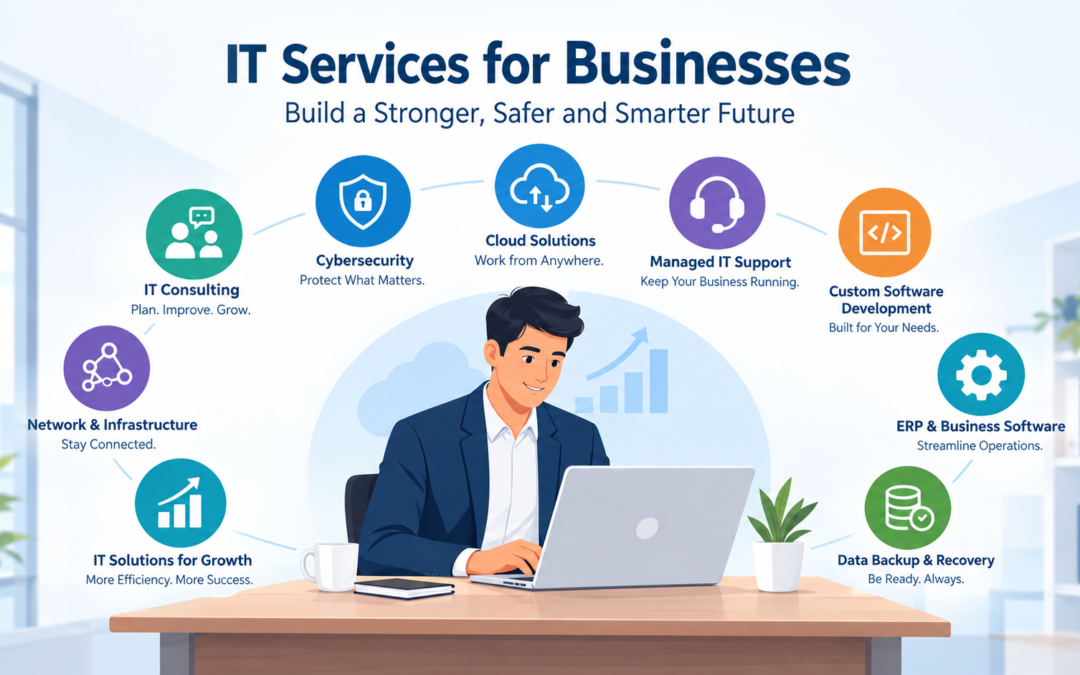
Common business IT services include: IT services for businesses
-
IT consulting and technology planning
-
Managed IT support and maintenance
-
Cybersecurity services
-
Cloud solutions and infrastructure
-
Custom software development
-
Network setup and management
-
Data backup and recovery
-
Business software implementation and integration
The services a company needs depend on its size, industry, existing technology, budget, and business objectives.
1. IT Consulting Services: How Can They Help Your Business?
Businesses often invest in technology without having a clear plan for how different systems should work together. This can lead to unnecessary expenses, inefficient processes, and software that does not meet business requirements.
IT consulting services help businesses evaluate their current technology and identify suitable improvements.
An IT consultant may help with: IT services for businesses
-
Assessing existing IT infrastructure
-
Identifying technology gaps
-
Planning digital transformation initiatives
-
Selecting appropriate software and hardware
-
Improving IT budgets and resource allocation
-
Developing a technology roadmap
For example, a company using separate tools for sales, accounting, and inventory may need guidance on whether an integrated business management system would be suitable.IT services for businesses
Business benefit: IT consulting helps organizations make informed technology decisions that align with their goals.
2. Cybersecurity Services: How Can You Protect Your Business?
Cybersecurity is an important consideration for businesses that use digital systems to store customer information, financial records, employee details, and other sensitive data.
Security incidents can disrupt operations, damage customer trust, and create financial or legal consequences.
Cybersecurity services can help businesses identify risks and strengthen their protection.
Common cybersecurity measures include:
-
Security assessments and risk identification
-
Firewall and endpoint protection
-
Access control and authentication
-
Email security and phishing awareness
-
Security monitoring
-
Software updates and vulnerability management
-
Backup and recovery planning
Businesses should also train employees to recognize suspicious emails, use strong authentication methods, and follow appropriate data-handling procedures. IT services for businesses
No security solution can eliminate every risk. A combination of technical safeguards, employee awareness, and regular reviews provides a stronger approach to protecting business systems.
Business benefit: Cybersecurity services help reduce security risks and support the protection of important business information.
3. Cloud Solutions: How Can They Improve Business Flexibility?
Cloud solutions allow businesses to use computing resources, applications, storage, and services through cloud-based infrastructure.
Depending on the solution, employees may be able to access authorized business applications from different locations without relying entirely on office-based systems.
Cloud services can support businesses by providing:
-
Flexible access to business applications
-
Cloud storage and collaboration tools
-
Scalable computing resources
-
Support for remote and hybrid work
-
Cloud-based backup options
-
Reduced reliance on some on-premises infrastructure
For example, a growing company with employees in multiple locations may use cloud-based applications to share information and coordinate work.
However, businesses should evaluate data security, access permissions, service availability, ongoing subscription costs, and regulatory requirements before migrating systems to the cloud. IT services for businesses
Business benefit: Suitable cloud solutions can support flexibility, collaboration, and business growth.
4. Managed IT Services: Why Is Ongoing IT Support Important?
When computers, networks, business applications, or other systems stop working, employees may be unable to complete their tasks. Unresolved technical problems can also affect customer service and productivity.
Managed IT services provide ongoing technology support based on an agreed service arrangement.
Depending on the provider and service plan, managed IT support may include:
-
Monitoring IT systems
-
Troubleshooting technical issues
-
Maintaining computers and networks
-
Managing software updates
-
Supporting users and employees
-
Monitoring system performance
-
Helping maintain backup procedures
For small and medium-sized businesses, external IT support may provide access to technical expertise without building a large internal IT department.
However, businesses should review service-level agreements, response times, coverage, responsibilities, and pricing before selecting a provider.
Business benefit: Reliable IT support can help reduce avoidable disruption and keep essential systems running more smoothly.
5. Custom Software Development: When Does Your Business Need It?
Ready-made software can meet many common business requirements. However, some organizations have unique workflows, industry-specific needs, or integration requirements that standard applications may not fully address.
Custom software development involves designing and building software around specific business requirements.
Examples include:
-
Customer and employee portals
-
Business management applications
-
Workflow automation tools
-
Customer relationship management systems
-
Web applications and mobile applications
-
Integration between existing software platforms
-
Custom reporting and dashboards IT services for businesses
Before developing a custom solution, businesses should clearly define the problem, required features, expected costs, security needs, and ongoing maintenance responsibilities.
In some cases, configuring existing software may be more cost-effective than developing a new application from scratch.
Business benefit: The right software solution can support specific workflows and help businesses address operational challenges.
6. ERP and Business Software Services: How Can They Streamline Operations?
Many businesses manage sales, finance, purchasing, inventory, and customer information through separate applications. When these systems are disconnected, employees may need to enter the same information repeatedly or manually combine reports.
Enterprise Resource Planning (ERP) software helps connect multiple business functions through an integrated system.
Depending on the selected software and configuration, ERP solutions can support:
-
Sales and customer management
-
Accounting and financial operations
-
Inventory and warehouse management
-
Purchasing and supplier management
-
Manufacturing and production
-
Project management
-
Business reporting and analysis
For example, an integrated workflow can make order information available to relevant teams and help connect sales, inventory, and invoicing processes.
Odoo ERP is one option businesses can evaluate when looking for modular business management software. The appropriate applications and implementation approach depend on the organization’s requirements. IT services for businesses
Successful ERP implementation typically involves business process analysis, system configuration, data migration, integrations, employee training, and ongoing support.
Business benefit: Integrated business software can improve information visibility, reduce duplicated work, and support more consistent processes.
7. Data Backup and Recovery: Is Your Business Prepared for Data Loss?
Business data can be affected by accidental deletion, hardware failure, cyberattacks, software problems, or other unexpected events.
A backup and recovery plan helps businesses prepare for these situations and restore important information when necessary.
Data protection services may include:
-
Automated data backups
-
Secure backup storage
-
Recovery planning
-
Backup monitoring
-
Regular restoration testing
-
Business continuity planning
Businesses should determine how frequently important data needs to be backed up and how quickly systems must be restored after an incident.
Keeping backup copies appropriately protected and testing recovery procedures are important parts of an effective plan.
Business benefit: Backup and recovery planning can help reduce downtime and support business continuity.
8. Network and Infrastructure Management: Why Does It Matter?
Business applications and connected devices depend on reliable network and IT infrastructure. Slow connections, network failures, or poorly configured systems can affect employee productivity.
Network and infrastructure services help businesses maintain the technology needed for daily operations.
These services may include:
-
Network setup and configuration
-
Wi-Fi and connectivity management
-
Server and infrastructure maintenance
-
Network performance monitoring
-
Device and access management
-
Troubleshooting connectivity issues
-
Infrastructure planning and upgrades
Businesses should ensure their infrastructure meets current operational needs and can accommodate expected growth.
Business benefit: Properly managed infrastructure supports reliable access to business applications and digital resources.
9. How Do You Choose the Right IT Services Company?
Selecting an IT services for businesses provider is an important decision because technology can affect almost every part of a business.
Before choosing a provider, consider the following factors. IT services for businesses
Understand Your Business Requirements
Identify the main challenges you want to solve. These may include cybersecurity risks, outdated software, unreliable IT support, disconnected business systems, or inefficient workflows.
Review Relevant Experience
Look for a provider with experience in the services and technologies your business requires. Ask about relevant projects, technical expertise, and support capabilities.
Evaluate Security Practices
Understand how the provider handles access controls, sensitive information, backups, updates, and security incidents.
Check Support and Communication
Review support availability, response times, escalation procedures, and the responsibilities covered by the service agreement.
Compare Costs and Value
Evaluate the complete cost, including setup, subscriptions, implementation, support, maintenance, and potential additional charges.
Consider Future Growth
Choose services that can adapt as your business adds employees, expands operations, or introduces new technology.
The right IT services provider should understand your business objectives and help you select practical solutions rather than recommending technology that does not meet your needs.
10. What IT Services for businesses Does a Small or Growing Business Need First?
Not every business needs every IT service immediately. Priorities depend on the company’s current systems, risks, and growth plans.
A practical starting point is to review the following areas:
Basic IT support: Ensure employees can get help with essential computers, applications, and network issues.
Cybersecurity: Protect business accounts, devices, applications, and sensitive information with appropriate security measures.
Data backup: Establish and test a backup and recovery process for important business data.
Cloud and collaboration tools: Evaluate whether suitable cloud applications can improve access to information and teamwork.
Business software: Review whether accounting, CRM, ERP, or other applications can simplify daily operations.
IT planning: Create a realistic plan for technology investments, upgrades, and future requirements.
Businesses can start with their most urgent needs and expand their IT services as their requirements change.
Conclusion: Which IT Services Will Help Your Business Grow?
The right IT services for businesses can help improve productivity, protect important information, simplify daily operations, and support long-term growth.
From IT consulting and cybersecurity to cloud solutions, managed support, custom software development, and ERP implementation, each service addresses different business needs.
The best approach is to assess your current technology, identify operational challenges, and prioritize services that deliver practical value. Regular reviews can help ensure your technology continues to support your business as it grows. IT services for businesses
At Fadel Software Solutions (FadelSoft), businesses can explore software and IT solutions aligned with their technology requirements and operational goals.
Ready to improve your business with the right technology?
Visit FadelSoft to learn more about available solutions and discuss your business requirements.
Contact FadelSoft
-
Website: https://fadelsoft.com/
-
Email: info@fadelsoft.com
-
Phone: +91 6309441721
Frequently Asked Questions (FAQs)
1. What are the most important IT services for businesses?
Common priorities include IT support, cybersecurity, data backup, cloud solutions, and business software. The right combination depends on business size, industry, risks, and operational requirements.
2. Why do businesses need IT services?
Businesses use IT services to maintain their technology, protect information, resolve technical issues, improve workflows, and support employees who depend on digital tools.
3. What is the difference between IT support and managed IT services?
IT support generally focuses on resolving technical problems and assisting users. Managed IT services often include ongoing monitoring, maintenance, and other services under an agreed service plan. The exact scope varies by provider.
4. Are cloud solutions suitable for small businesses?
Cloud solutions can suit small businesses that need flexible access to applications, storage, or collaboration tools. Businesses should assess security, connectivity, costs, and compliance before choosing a solution.
5. How can IT services improve business productivity?
IT services for businesses can help reduce technical interruptions, connect business applications, automate repetitive activities, improve access to information, and support more efficient workflows.
6. How do I choose an IT services for businesses provider?
Evaluate the provider’s relevant experience, security practices, service scope, response times, communication, pricing, and ability to support your future requirements.